You Asked Your Team to Be Creative. Did You Give Them Permission to Be Wrong?
- Interlock & Infinity

- Jul 21
- 4 min read

Written by: Jessica Low
“Give us your best idea.”
It sounds like an invitation to think creatively. Yet, in many workplaces, it lands more like a test.
Employees look around the room. Who is listening? Will this idea sound naïve? Has someone already suggested the direction the leader prefers? What happened the last time a colleague offered something unusual?
Then the room becomes quiet—or a few familiar voices begin speaking.
I have seen this pattern in facilitated conversations. People are invited to generate ideas, but they are also carrying memories from previous teams: being dismissed, corrected too quickly, laughed at, interrupted, or asked to return only when they have “the solution.”
So, can we TEACH creativity?
I believe we can teach creative-thinking processes. Research reviews have found that creativity training can improve creative performance, particularly when it teaches practical cognitive methods and gives people opportunities to apply them. A more recent meta-analysis focused on organisational settings also found positive effects from creativity training. But teaching the skill is only half the work. People still need an environment in which they can use it.
We Learned to Search for the Right Answer
From a young age, many of us became familiar with questions that had one correct answer. We learned to apply logic and avoid mistakes.
Organisations still need analysis, accuracy and sound judgment.
The difficulty comes when we carry the same answer-seeking habit into a problem that does not yet have a clear answer.
When leaders ask, “What is the solution?” they may believe they are creating focus. But the question can push the team towards certainty before it has explored the problem. Employees filter their thoughts before speaking. They offer ideas that sound sensible, safe and close to what has worked before.
Then we wonder why the brainstorming session produces FAMILIAR answers.
Creativity Needs Two Different Modes of Thinking
Creative problem-solving moves between two modes.
Divergent thinking opens the field. It asks: What else could be possible? How many different directions can we see? What would we suggest if feasibility were not the first concern?
Convergent thinking narrows the field. It asks: Which ideas best fit our purpose, constraints and resources? What should we combine, test or take forward?
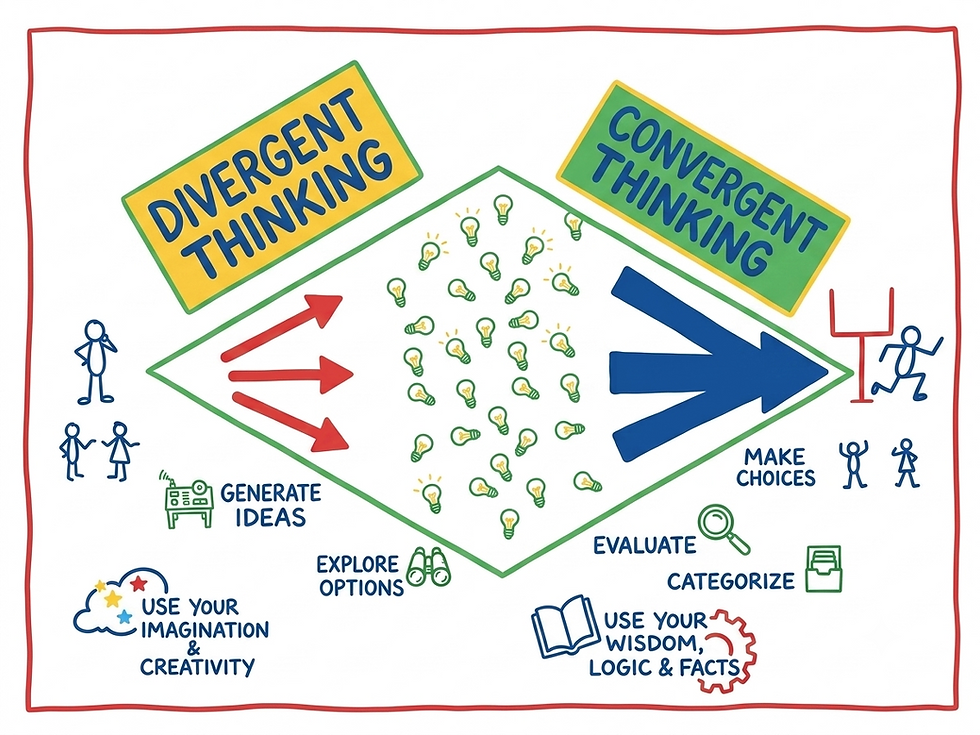
Both are necessary. The problem is that many teams converge too early.
One idea appears, and the conversation immediately shifts to improving it. Someone asks whether it is practical. Another person lists the risks. Before the team has produced real variety, the funnel has already narrowed.
A useful idea-generation process should first widen the funnel. The aim is not to execute every wild idea. It is to create enough difference that the team has something meaningful to evaluate.
A Room Full of People Does Not Guarantee a Room Full of Ideas
I once described the pattern as an 80/20 problem: a small proportion of participants seem to produce most of the spoken ideas. I would treat that as an observation, not a universal statistic.
The question is: if only a few people are contributing, why did we invite everyone else?
Research on verbal group brainstorming helps explain the gap. When people must take turns, ideas can be forgotten or interrupted while they wait. This is known as production blocking. People may also hold back because they fear evaluation or embarrassment.
Studies have found that people brainstorming separately and then pooling their ideas can outperform groups relying only on open verbal discussion.
Collaboration still matters, but it needs design.
Two brains are not automatically better than one. Two differently experienced brains become valuable when both have a real way to contribute.
Four Conditions That Make Creativity More Teachable
1. Separate Generation from Evaluation
Make it clear which mode the team is using. During divergence, suspend feasibility debates. During convergence, introduce criteria and make decisions.
Mixing the two encourages premature judgment.
2. Let People Think Before They Speak
Begin with individual writing or silent idea generation. Then collect ideas before opening the discussion.
This gives quieter, less senior or more reflective participants an entry point. It also reduces the session’s dependence on whoever is confident enough to speak first or fast enough to keep speaking.
3. Ask for Possibilities, Not Final Answers
Replace “What is the solution?” with questions such as:
What are three different ways we could approach this?
What have we not considered?
What would someone from another function see?
What could we test on a small scale?
A question can either open thinking or close it.
Leaders need to notice whether their questions invite exploration or signal that they are waiting for one acceptable answer.
4. Respond Carefully to Unfinished Ideas
Psychological safety is a shared belief that a team is safe for interpersonal risk-taking. Research links it with team learning behaviour, while workplace-creativity research shows that organisational environments can contain both stimulants and obstacles to creativity.
Leaders create the real rules through their reactions.
Saying “all ideas are welcome” matters less than what happens when an idea is incomplete, unconventional or wrong.
Is the person questioned with curiosity?
Is the idea explored before it is evaluated?
Or does a facial expression, dismissive comment or quick joke teach everyone else to remain silent?
A Leadership Checklist for the Next Brainstorming Session
Before asking your team to be creative, consider:
Have we defined a meaningful problem without prescribing the answer?
Are idea generation and evaluation clearly separated?
Does everyone have time to think independently?
Can people contribute without competing for airtime?
Are senior voices entering too early?
What will I say when an idea sounds unrealistic?
Are we rewarding thoughtful experiments, or only successful outcomes?
What is the smallest safe test we can run after the session?
Who will own the next step?
Creativity is not only about producing a clever idea in a workshop. It is about building repeated permission to question, explore, test, learn and refine.
Perhaps the better leadership question is not:
“Are my employees creative?”
It is:
What happens in my team when someone offers an idea that is unfinished, unusual or wrong?
The answer reveals the environment you have built.
And that environment may be teaching your people far more about creativity than any workshop ever could.

Comments